Previous
Next
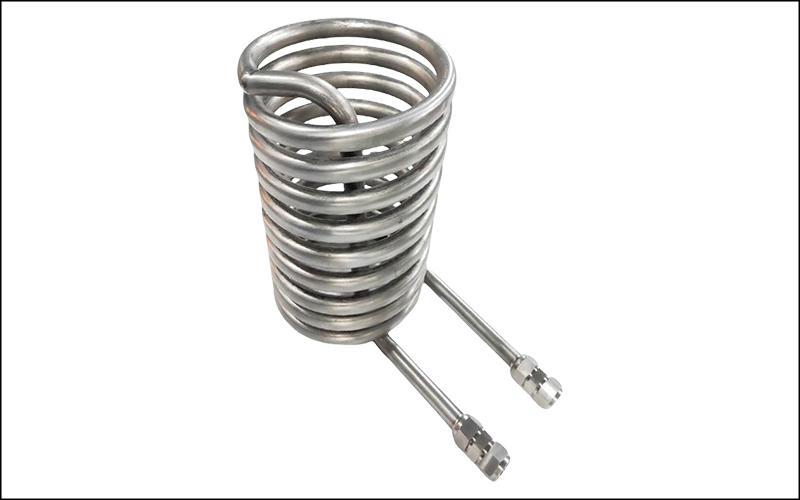
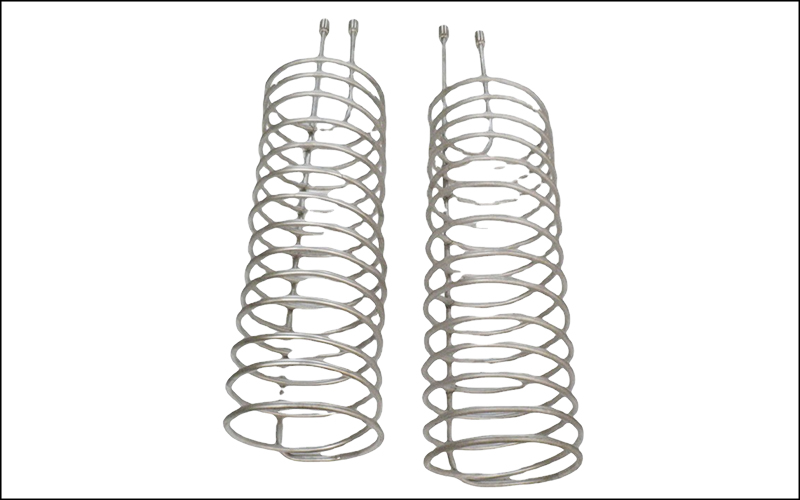
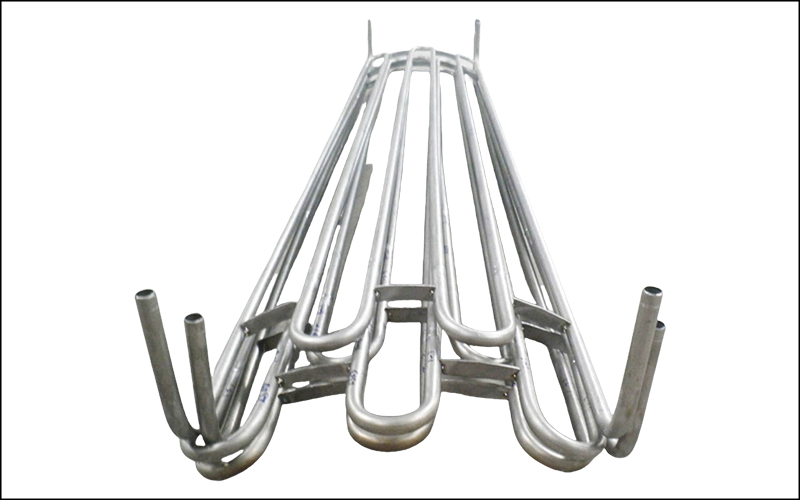
Titanium Coil Tube
Material properties and classification:
Titanium coils are made from industrially pure titanium and titanium alloys, with a density of approximately 4.51 g/cm³. They offer high strength (tensile strength 345-1400 MPa), excellent corrosion resistance (especially resistance to seawater and chloride ion corrosion), and high and low-temperature stability (applicable to temperatures ranging from -253°C to 600°C).
Production method
Titanium coils are first produced as billets, which are then processed through a bending process. The core process is as follows:
1. Tube Preparation (primarily seamless tubes):
Smelting and Casting: Titanium sponge or recycled material is melted in a vacuum consumable furnace into ingots 500-800 mm in diameter. The oxygen content is controlled to ≤ 0.2% to ensure plasticity.
Forging and Opening: Heating to 50-100°C below the β transformation point (approximately 900°C for TA2) and forging into billets 150-300 mm in diameter.
Rolling and Piercing: The billet is rolled into rough tube using a three-roll cross-roll piercing mill. It is then cold-rolled (20-roll mill, 15%-25% deformation per pass) to the target wall thickness (0.5-10 mm). Vacuum annealing (500-750°C, hold temperature 2-4 hours) is performed to eliminate work hardening
2. Tube Bending:
Using a CNC tube bender, straight tubes are bent into coils through cold or hot bending (heating to 300-400°C). The bending radius R should be ≥ 3D (D is the tube diameter) to prevent cracking
After bending, stress relief annealing (450-550°C) and pickling (HF+HNO₃ solution) are performed to remove scale and surface impurities.
| Titanium coil product parameters | |
| Product Name | Titanium coil |
| Material | Pure titanium and titanium alloys |
| Specification | Round titanium coils, square titanium coils, serpentine titanium coils U-shaped titanium coils, S-shaped titanium coils, titanium double-layer coils Titanium tube heat exchangers, titanium U-tube heat exchangers, etc |
| Brand | GR1/GR2/GR7/GR12/GR5 |
| Standards | ASTM B265,ASTM B348,ASTM B381,ASTM B337,ASTM B338 |
Core Purpose:
Chemical/Marine Engineering: Desalination heat exchangers, chlor-alkali electrolyzers, and ship cooling systems, relying on their resistance to Cl⁻ corrosion.
Energy: Nuclear power condenser piping, geothermal energy transmission pipes, and LNG storage tank coils, withstanding high temperatures, high pressures, and media corrosion.
Pharmaceutical/Food: Pharmaceutical reactor coils and food-grade heat exchangers, meeting hygienic requirements (non-toxic, no precipitation).
Aerospace: Satellite propulsion system piping and aircraft hydraulic piping, requiring lightweight design and resistance to extreme environments. Through material composition control and precision forming processes, titanium coils can achieve complex curvatures and thin walls (minimum wall thickness 0.3mm), replacing stainless steel or nickel-based alloys in lightweight, corrosion-resistant applications, reducing overall lifecycle costs.